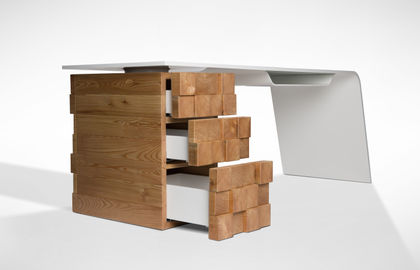


Creative industries represent a vibrant segment with many prolific designers, computer game developers, artists, photographers, and architects. The first Slovenian unicorn – a start-up valued over 1 billion US dollars – came from this thriving sector. Slovenian products, ranging from skis and yachts, to furniture, smart bottles, and lightning systems, are regularly among the recipients of top design awards.
It is not a coincidence. Culture was the main constituent of the ethnic identity before Slovenians got their first state in 1991. Slovenians got their first printed book in 1550, while their first great composer was Jakob Petelin, globally known as Jacobus Gallus, one of the great renaissance masters. Several great architects of Slovenian ethnicity were active in the first half of 20th century, most notably Jožef Plečnik. Plečnik was also an excellent designer and could be considered to a large degree as one of the fathers of contemporary Slovenian design.
This heritage forms a strong foundation for the dynamic cultural life of today. The cultural and creative industries are already a flagship of the Slovenian economy – and their relative importance is only growing.


Two iconic products of mid-20th century Slovenian design are Davorin Savnik’s ETA telephone manufactured by Iskra, and the Rex chair by Niko Kralj – a creator of furniture with strict modernist form. Both products are a part of New York’s Museum of Modern Arts’ (MoMA) regular collection. And yet the true Golden Age of Slovenian design and architecture has only come after the country’s independence in 1991. Each year several Slovenian industrial products receive international design awards, including the Red Dot award. Young architects using natural and recycled materials are regularly featured in leading design magazines like Dezeen. Furniture designer Nika Zupanc is a regular star performer at Milan Design Week with her recognizable techno-chic style. The best Slovenian design solutions are regularly exhibited at design fairs in Paris and Copenhagen. Designs from leading Slovenian fashion and jewelry creators are worn by global celebrities. Slovenian architects and designers often use wood for their creations, like for example original wooden boat interior designs, emphasizing sustainability. Design also seems to be one of the main selling points of young start-ups finding success on crowdfunding platforms.
Slovenia has a rich cultural life with many galleries, museums, performing arts venues, and festivals. Ljubljana’s philharmonic society was established back in 1701 and in the past included among its members composers like Beethoven, Haydn, and Brahms. The square in front of its building today serves as a venue for the Ljubljana Festival, a major event attracting top performers of classical music – Placido Domingo, Riccardo Muti, or Ana Netrebko. Visual arts are also well developed: Slovenian photographers publish their work in major global media, including National Geographic (not to forget: the first globally recognized blind photographer Evgen Bavčar is an ethnic Slovenian living in France). Slovenian independent and low budget films often garner attention at film festivals. Another aspect: global filmmakers are increasingly using the picturesque and dynamic scenery of Slovenia for their shooting locations. Apart from the more classical culture, there’s also a vibrant alternative production scene - most notably in Ljubljana’s Metelkova, a conglomerate of art venues in abandoned army barracks. And finally, folk music: the Oberkrainer band sold over 12 million records worldwide in the sixties and seventies. Their composition “At the mountain of Golica” (Trompeten Echo in German speaking parts of Europe) is the most played instrumental song in the world.
The first Slovenian unicorn – a start-up valued over 1 billion US dollars – was the company behind Talking Tom, a popular mobile app character. The local gaming industry has produced several global bestsellers. 3D solutions developed by computer scientists from Slovenia are used in Hollywood blockbuster movies and series including The Hobbit and Game of Thrones.
Slovenian writers like Drago Jančar, Tomaž Šalamun, Boris Pahor, and philosopher Slavoj Žižek, are translated worldwide. Young and creative book publishers have overcome the language barrier with original solutions like personalized children’s books. They are sold in millions on major markets in Europe and North America. Slovenia is to be the guest of honor at the 2023 Frankfurt Book Fair.
In various international comparisons Slovenia scores high on human capital. The World Bank’s Human Capital Index* analysis globally ranks Slovenia 14th – and 6th in the European Union. And obviously, this human capital is behind the nation's creative potentials. A few examples of Slovenian talent: In the 19th century ethnic Slovenians were among the pioneers of photography and inventors of such items like postage stamps**. Herman Potočnik was a visionary pioneer of space exploration. Peter Florjančič, serial entrepreneur, actor in a James Bond movie, musical composer, and Olympic athlete, invented numerous everyday objects from plastic frames for diapositives to the perfume atomizer. The modern successors of Potočnik and Florjančič use crowdfunding platforms to gain global recognition. These young entrepreneurs combine original design solutions with new ideas and create products ranging from a levitating turntable to wooden pinhole cameras, or a scooter combined with a trolley and backpack.
Perhaps not a typical “creative” industry, yet without a doubt an essential ingredient of any culture: its cuisine. In the last decade Slovenian cuisine has emerged onto the global scene and grown from a curio known to a handful of connoisseurs to one of Europe’s “must-go culinary destinations” (Michelin). Slovenia has so far been the only country to be named European Region of Gastronomy in its entirety (2021) and cuisine has become one of Slovenia’s key tourist attractions. The new Slovenian cuisine – as practized by Ana Roš and other chefs praised by Michelin, Gault & Millau, and international press – is unique, healthy, and based on local, sustainably produced ingredients. Finally: Janez Bogataj’s books featuring Slovenian and Mediterranean cuisine have won several world’s best cookbook awards.