

An improved traffic network and logistics infrastructure strengthen Slovenia’s role as a key logistics hub in a strategic location.
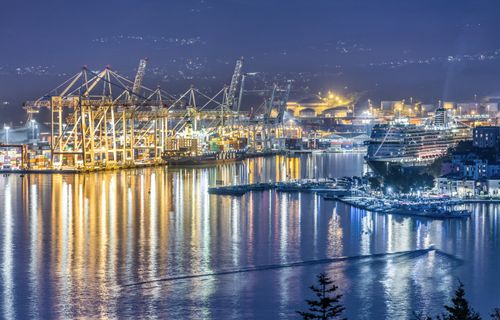
The most important investment now is the second railway line connecting the port of Koper with Ljubljana, and with it also to Central Europe. Conveniently located, Koper offers the fastest link between the Mediterranean – and thus also Asia – and Central Europe: Austria, Czechia, Slovakia, and southern Germany. Luka Koper is the fifth-largest car terminal in Europe and the largest in the Mediterranean, with 914,000 cars handled in 2025. It is also an important container terminal, with 1.27 million TEU of container traffic in 2025 — just shy of the quantities handled in French Marseille. The new line will bring significant time savings and should further strengthen the port’s competitiveness. Port authorities are also investing in the port’s sustainability, a new container quay, storage areas, a garage with a capacity of 11,700 vehicles, and increased automation, along with the implementation of the Smart Port concept. €133 million were invested in 2025, with a further €201 million earmarked for 2026. The total value of investments in the period 2024–2028 amounts to €785 million — remarkable figures in comparison to the port’s net sales, which reached €380 million last year.
The second important Slovenian logistics hub is Ljubljana’s Airport. A total of 27,186 tonnes of cargo passed through its air cargo center. This is not a large figure; however, the advantage of Ljubljana’s Airport lies in its specialization. The Airport has evolved into a regional center for pharmaceutical and biotechnology air cargo, featuring infrastructure specifically designed to handle temperature- and quality-sensitive biopharmaceutical shipments. The airport will also gain a new business park with over 10,000 m2 of available office space. Construction should be completed in 2027. The government also plans to connect the airport to the city centre by fast railway, most probably in the next decade.
Another major investment in transport infrastructure is Ljubljana’s new multimodal passenger centre, which should be finished next year. The state has also begun preparations for constructing a new motorway connecting Slovenia with the Croatian port of Rijeka. Construction of motorways connecting the regions of Koroška in the north and Bela Krajina in the south has already started.
Slovenia’s greatest asset is its strategic geographic location. From the capital, Ljubljana, key European industrial and financial hubs such as Milan, Vienna, Munich, and Budapest are accessible within one hour by air or about five hours by car. This exceptional connectivity delivers real benefits, including lower logistics costs and improved supply chain reliability. With enhanced infrastructure, these advantages become even more compelling and valuable.